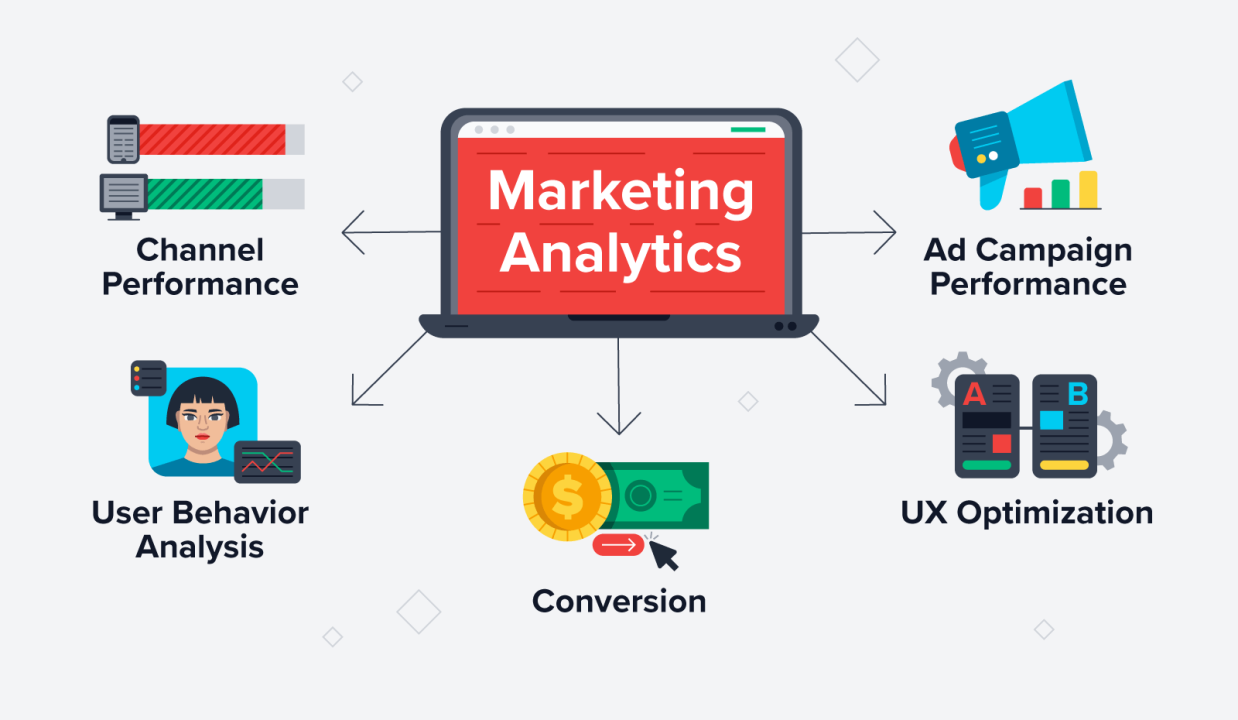
In today’s digital-first business environment, marketing analytics has become one of the most valuable assets for organisations seeking sustainable growth. In 2026, brands generate vast amounts of data from websites, social media platforms, email campaigns, paid advertising, customer interactions, and e-commerce channels. However, collecting data alone is no longer enough. The true competitive advantage lies in understanding how to analyse, interpret, and apply that data effectively.
Marketing analytics allows businesses to measure performance, understand customer behaviour, improve campaigns, and maximise return on investment. Yet many organisations still struggle with fragmented systems, unclear reporting, inaccurate data, or metrics that fail to translate into meaningful business decisions.
Optimising marketing analytics is not simply about adopting new software or creating more reports. It involves building a strategic framework that transforms raw data into actionable insights. Businesses that optimise their analytics effectively can improve customer targeting, increase conversions, reduce wasted spending, and make more confident decisions.
This article explores seven key ways to optimise your marketing analytics for maximum impact in 2026 and beyond.
1. Define clear business goals and measurable KPIs
One of the biggest mistakes organisations make with marketing analytics is collecting large amounts of data without clear objectives.
Analytics should always support broader business goals. Without clear direction, teams may focus on vanity metrics that look impressive but provide little strategic value.
Before analysing performance, businesses should identify what they actually want to achieve. These objectives may include:
- Increasing website conversions
- Improving customer retention
- Growing brand awareness
- Reducing customer acquisition costs
- Increasing return on advertising spend
- Expanding market share
Once goals are established, organisations should define measurable key performance indicators (KPIs) that directly support those objectives.
For example:
- Conversion rate for lead generation campaigns
- Customer lifetime value for retention strategies
- Cost per acquisition for paid advertising
- Email open and click-through rates for engagement campaigns
Clear KPIs help marketing teams focus on the data that matters most.
Importantly, businesses should avoid measuring too many metrics simultaneously. Excessive reporting can create confusion and reduce clarity. Instead, organisations should prioritise the metrics that align most closely with strategic goals.
When goals and KPIs are clearly defined, analytics becomes far more meaningful and actionable.
2. Centralise your data for better visibility
Modern marketing campaigns often operate across multiple channels, including:
- Social media
- Search engines
- Email marketing
- Websites
- Mobile applications
- CRM systems
- Paid advertising platforms
One major challenge organisations face is fragmented data spread across disconnected systems. When information exists in separate platforms, it becomes difficult to gain a complete understanding of customer behaviour and campaign performance.
Centralising marketing data is therefore essential for optimisation.
A unified analytics system allows businesses to combine data from multiple sources into a single dashboard or reporting environment. This creates a clearer picture of how channels interact and contribute to overall performance.
Benefits of centralised analytics include:
- Improved reporting accuracy
- Faster decision-making
- Better customer journey analysis
- Reduced duplication and inconsistencies
- More efficient collaboration between teams
For example, a centralised dashboard may show how social media campaigns influence website traffic, which then contributes to email sign-ups and eventual sales conversions.
Without integration, these relationships may remain hidden.
Businesses should also ensure that departments such as marketing, sales, and customer service share relevant insights. Cross-functional visibility improves strategic alignment and customer understanding.
3. Prioritise data quality and accuracy
Even if you optimise your marketing analytics with the most advanced systems, they can be ineffective if the underlying data is inaccurate or incomplete.
Poor data quality can lead to:
- Misleading insights
- Incorrect targeting
- Wasted advertising spend
- Faulty decision-making
Inaccurate data often results from inconsistent tracking, duplicate records, incorrect attribution settings, or outdated customer information.
To optimise marketing analytics effectively, businesses must prioritise data hygiene and governance.
This includes:
- Regularly auditing tracking systems
- Removing duplicate or outdated records
- Ensuring accurate attribution models
- Standardising naming conventions across campaigns
- Validating data sources consistently
For example, inconsistent UTM parameters in digital campaigns can create fragmented reports that distort performance analysis.
Businesses should also establish clear data management processes and responsibilities to maintain consistency over time.
Accurate data is the foundation of reliable analytics. Without it, even sophisticated tools cannot deliver meaningful insights.
4. Use predictive analytics and artificial intelligence
Artificial intelligence and predictive analytics are becoming increasingly important in marketing strategy.
Traditional analytics focuses primarily on historical performance. Predictive analytics, however, uses machine learning and behavioural patterns to forecast future outcomes.
In 2026, businesses are increasingly using AI-powered analytics to:
- Predict customer behaviour
- Identify likely conversions
- Forecast campaign performance
- Detect churn risks
- Personalise customer experiences
For example, predictive models may identify customers most likely to make repeat purchases or highlight audiences with higher conversion potential.
AI can also automate data analysis, helping teams identify patterns and anomalies more quickly than manual reporting processes.
Benefits of predictive analytics include:
- More proactive decision-making
- Better audience targeting
- Improved campaign efficiency
- Increased personalisation
- Faster optimisation cycles
However, businesses should avoid relying entirely on automation. Human interpretation remains essential for understanding context, ethics, and broader business implications.
The most effective organisations combine AI-driven insights with strategic human judgement.
5. Focus on customer journey analytics
Modern customer journeys are increasingly complex.
Consumers may interact with a brand multiple times across different devices and platforms before making a purchase decision. A customer may:
- Discover a brand through social media
- Visit the website through organic search
- Sign up for email updates
- Engage with retargeting ads
- Finally convert after several interactions
Traditional last-click attribution models often fail to capture the full complexity of these journeys.
To optimise marketing analytics, businesses should adopt customer journey analysis that examines the entire path to conversion.
This involves tracking:
- Multi-channel interactions
- Customer touchpoints
- Behavioural patterns
- Engagement timing
- Device usage
Customer journey analytics helps organisations understand which channels and interactions contribute most effectively to conversions.
For example, businesses may discover that educational content significantly influences purchasing decisions even if it does not generate direct conversions itself.
Understanding these relationships allows marketers to allocate budgets more effectively and improve the overall customer experience.
Customer journey analysis also supports better personalisation by identifying where customers may require additional support or engagement.
6. Improve reporting and visualisation for decision-making
Many organisations collect valuable data but struggle to present it clearly.
Complicated spreadsheets and overloaded dashboards can overwhelm teams and make decision-making more difficult.
Effective analytics reporting should focus on clarity, relevance, and actionability.
Best practices for reporting include:
- Using simple and visually clear dashboards
- Highlighting trends and insights rather than raw numbers alone
- Customising reports for different stakeholders
- Focusing on business impact rather than vanity metrics
- Automating regular reporting where possible
Executives may require high-level strategic summaries, while marketing teams may need more detailed campaign analysis.
Visualisation tools such as graphs, charts, and performance heatmaps help teams identify trends quickly and communicate insights more effectively.
For example, a visual funnel analysis may reveal where customers drop off during the conversion process, enabling targeted improvements.
Good reporting transforms analytics from passive information into practical business intelligence.
7. Continuously test, optimise, and adapt
Marketing analytics should never be treated as a static process.
Consumer behaviour, technology, algorithms, and market conditions are constantly evolving. As a result, organisations must continuously refine their strategies and optimise campaigns based on data insights.
Continuous optimisation involves:
- Running A/B tests regularly
- Experimenting with messaging and creatives
- Monitoring emerging trends
- Analysing competitor activity
- Reviewing campaign performance frequently
Testing helps businesses identify what actually works rather than relying on assumptions.
For example, marketers may test:
- Different email subject lines
- Advertisement visuals
- Landing page layouts
- Call-to-action placements
- Audience segments
Small adjustments can often produce significant improvements in engagement and conversion rates.
Importantly, optimisation should be an ongoing cycle rather than a one-time task. Successful organisations create cultures of experimentation and learning where analytics drives continuous improvement.
The growing role of privacy and ethical analytics
As marketing analytics becomes more advanced, privacy and ethical considerations are becoming increasingly important.
Consumers are more aware of how their data is collected and used. Regulations surrounding data protection continue to evolve globally.
Businesses must therefore ensure that their analytics practices are transparent, ethical, and compliant.
Key considerations include:
- Obtaining clear user consent
- Protecting customer data securely
- Avoiding intrusive tracking practices
- Being transparent about data usage
Ethical analytics practices help build trust with customers and reduce reputational risks.
In 2026, businesses that prioritise privacy and responsible data management are likely to gain stronger long-term customer loyalty.
Aligning analytics with broader business strategy
Marketing analytics should not operate in isolation from broader business objectives.
To maximise impact, analytics insights should inform:
- Product development
- Customer service improvements
- Sales strategies
- Brand positioning
- Business forecasting
Cross-department collaboration ensures that insights contribute to overall organisational growth rather than remaining confined to marketing teams.
For example, customer feedback data from marketing analytics may reveal product issues that need operational attention.
Integrated business intelligence creates more cohesive and effective strategic decision-making.
Building a data-driven organisational culture
Technology alone cannot help to optimise your marketing analytics successfully.
Organisations also need a culture that values data-driven decision-making.
This includes:
- Encouraging curiosity and experimentation
- Training teams in analytics literacy
- Reducing reliance on assumptions
- Promoting collaboration across departments
When employees understand how to interpret and apply data insights, analytics becomes more impactful across the organisation.
Leadership support is also essential. Decision-makers must prioritise analytics as a strategic business function rather than a purely technical activity.
Preparing for the future of marketing analytics
The future of marketing analytics will likely involve even greater integration of artificial intelligence, automation, predictive modelling, and real-time decision-making.
Emerging trends include:
- AI-generated marketing recommendations
- Real-time customer behaviour tracking
- Voice and conversational analytics
- Advanced personalisation engines
- Cross-platform attribution improvements
Businesses that invest in adaptable analytics infrastructure today will be better positioned to respond to future changes.
However, despite technological advancements, the core purpose of analytics remains the same: understanding people and making better decisions.
Closing Thoughts
Marketing analytics has evolved from a supplementary business function into a central driver of modern marketing success. In 2026, organisations that optimise their analytics effectively gain significant competitive advantages through better decision-making, improved customer understanding, and stronger campaign performance.
By defining clear goals, centralising data, prioritising data quality, leveraging predictive analytics, analysing customer journeys, improving reporting, and continuously optimising campaigns – businesses can transform raw information into meaningful strategic insights.
At the same time, organisations must remain mindful of privacy, ethics, and the human side of marketing. Technology can provide valuable intelligence, but successful marketing still depends on understanding customer needs, emotions, and behaviours.
Ultimately, the most effective ways to optimise your marketing analytics strategies are those that combine technological innovation with strategic clarity, adaptability, and customer-focused thinking. Businesses that embrace this balanced approach will be best positioned to maximise impact and thrive in an increasingly data-driven world.